
Everyday Nutrition
Mapping the Rhythm of a Balanced Plate
Eleanor Whitfield··10 min read
London, March 2026 — A food journal is a record of meals, but it is also something else: a mechanism for slowing the act of eating down enough that it registers as a deliberate choice rather than an automatic behaviour. The research basis for this observation is well-established. Studies consistently show that people who record their food intake have a more accurate picture of what they actually eat than those who rely on retrospective recall — and a more accurate picture is the beginning of informed adjustment.
Mindful eating, as a documented practice, does not require meditation or a formal protocol. At its operational core, it requires noticing: noticing what is being eaten, in what quantity, at what pace, and in what state of attention. The food journal is one of the most practical tools for operationalising this noticing because it introduces a deliberate pause between the act and the record.
The pause itself is the intervention. A person who writes down what they are about to eat, or what they have just eaten, engages a different cognitive mode than one who eats without reference to any record. This is not a question of willpower — it is a question of attention. The food journal directs attention toward the eating event in a way that eating alone does not reliably produce.
Published research in the nutritional psychology literature consistently identifies this attentional mechanism as the primary active ingredient in food journaling's positive associations with dietary quality. The journal does not change what food is available. It changes how much of it enters consciousness before it enters the mouth. That difference, accumulated across meals and weeks, produces the pattern shifts that appear in the longer-term dietary data.
The most consistently useful food journals, as reviewed in the published literature and observed editorially, record five elements: what was eaten, how much (approximate portion), when, the context (location, concurrent activity), and a brief note on hunger or fullness at the time. These five fields take roughly two minutes per meal to complete and produce a picture that is substantially more informative than a calories-only record.
The context field is the most often omitted and the most informative. Eating while working at a screen, eating while standing in a kitchen, eating in a car, eating at a table with deliberate attention — these contexts produce reliably different portion outcomes even when the same food is involved. A journal that records context over two weeks makes this pattern visible in a way that memory alone does not.
The hunger and fullness notation does not require a specialist scale. A simple three-point observation — hungry, neutral, full — entered at the time of eating gives the food journal a dimension that makes retrospective review genuinely useful. Over several weeks of entries, a pattern emerges around the eating contexts that most reliably produce overshoot past comfortable fullness, and those that align with a sense of appropriate sufficiency.
"The journal does not change what food is available. It changes how much of it enters consciousness before it enters the mouth."
— Field note, London archive, March 2026
Portion control, as a concept, has a slightly adversarial register in popular nutritional culture — something imposed from outside, at odds with appetite. The food journal reframes it as portion awareness: not a restriction but a calibration. The distinction is consequential. Restriction implies that normal appetite is a problem to be overcome; awareness implies that appetite signals are information to be understood.
The published evidence base on portion size consistently identifies that the visual and contextual cues surrounding a meal — plate size, serving vessel, ambient noise level, eating speed — influence portion intake in ways that operate below deliberate awareness. A food journal, over time, builds the deliberate awareness layer that these automated cues bypass. It is not that journalling people eat less; it is that they eat with greater correspondence between what they intend and what they consume.
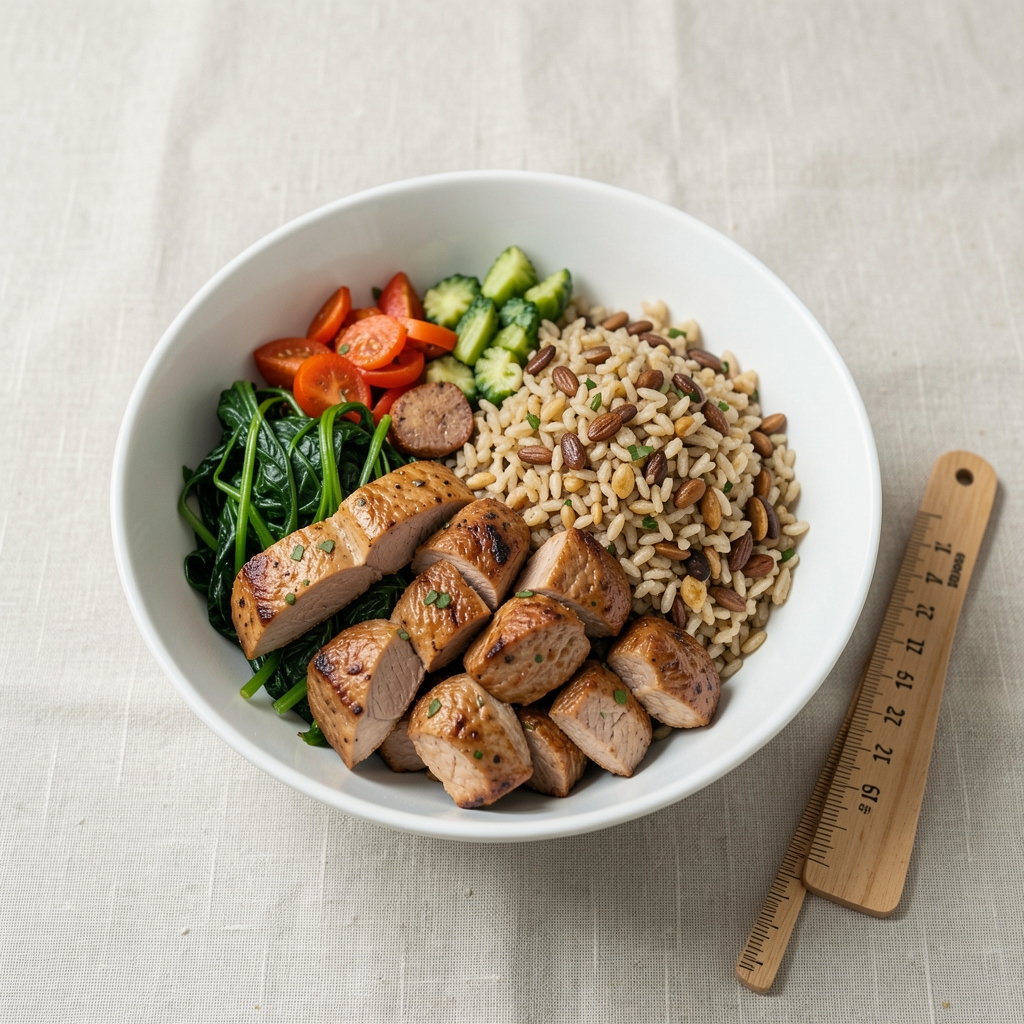
The practical technique most supported by published behavioural nutrition research is to serve a considered portion, eat it, then pause before returning for more. The pause — even a brief three minutes — allows satiety signals to begin registering. The food journal supports this by creating a moment at the beginning of each eating occasion where the portion is noticed before eating begins.

The food journal's companion document — used by the majority of people who report sustained dietary improvement in published cohort studies — is the weekly menu. Where the journal records what happened, the weekly menu records what is intended. Together they form a feedback loop: the menu sets the intention, the journal records the reality, and the gap between the two is the productive zone of observation and adjustment.
A useful weekly menu is not a rigid directive. It is a shopping scaffold: a list of meals for the week that determines what enters the home kitchen, which in turn determines what is available to eat without deliberate decision-making. Grocery planning based on the weekly menu is one of the most reliably cost-effective nutritional interventions available, because it replaces in-the-moment food choices — which are subject to appetite, fatigue, and availability bias — with intentional advance decisions.
The integration of seasonal produce into the weekly menu has an additional structural benefit: it narrows the choice space in a productive direction. A week built around available winter vegetables — leek, celeriac, kale, parsnip, dried legumes — produces a menu with built-in variety and a strong fibre foundation, without requiring exotic sourcing or complex preparation.
The sustainable weight approach documented most consistently in the published literature is not characterised by dramatic intervention but by gradual, persistent adjustment in habitual eating patterns. The food journal's role in this is specifically as a long-view tool: it is most valuable not in the first fortnight but in the third and fourth month, when the initial motivation to change has settled and the daily routine has either embedded or eroded.
Nutritionist guidance consistently identifies the six-week mark as a transition point: those who maintain a food record past six weeks tend to sustain their dietary adjustments at significantly higher rates than those who abandon the practice within the first month. The journal, by this point, has become a record of an established routine rather than a monitoring mechanism for a new one.
The food journal is not the only tool available for developing a more deliberate relationship with nourishment. But it is one of the most accessible: it requires no specialist knowledge, no equipment, and no commercial product. It requires only a notebook, consistent use, and the willingness to look at what the record reveals. The looking, sustained over time, is where the real work happens.
Articles published on Narbel Letters are editorial in nature and reflect the writers' observations on everyday wellness practices. The content is not intended as professional guidance, nor as direction for the management of any specific condition. Readers with specific concerns about their daily routines are encouraged to speak with a qualified wellness professional.

Eleanor Whitfield is a contributing editor at Narbel Letters, covering everyday nutrition, meal composition, and the published dietary evidence base. Her editorial practice is grounded in published nutritional science and practical kitchen observation across multiple seasons of journaling.
More from this author